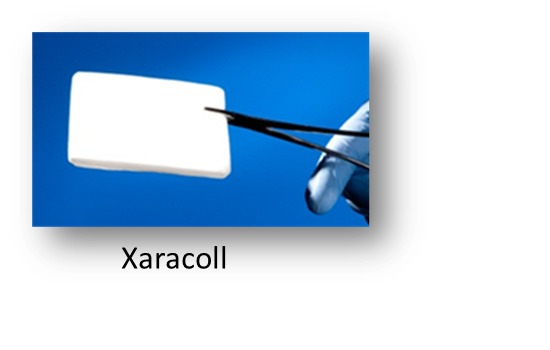
XaraColl
XaraColl is a surgical implant for the sustained delivery of bupivacaine hydrochloride, a locally-acting anesthetic, for the management of postoperative pain.
It is specifically formulated and manufactured for perioperative implantation using Innocoll's proprietary collagen-based drug delivery technology, CollaRx®. Once implanted, the product releases bupivacaine hydrochloride to provide local analgesia for 48-72 hours, thus reducing dependence on systemic opioid therapy for postoperative pain relief.
Key Feature
A key feature of XaraColl is the ability to position the implant at different layers within the surgical wound to specifically target the areas of high tissue trauma, such as across the peritoneal incision and directly below the skin incision. This enables localized treatment of both the incisional and deep, visceral pain components normally associated with moderate and major surgery. The bioresorbable nature of the collagen matrix also offers significant clinical benefits and convenience advantages over ambulatory infusion pumps, which some practitioners currently use for continuous, long-term analgesia at the surgical wound.
Clinical Development
The Phase 1 and Phase 2 programs evaluating XaraColl's efficacy, safety, and pharmacokinetics (PK) are complete and included studies in patients undergoing herniorrhaphy and hysterectomy. Based upon particularly encouraging results from the double-blind, placebo-controlled herniorrhaphy studies, the Phase 3 program is focused on the management of postoperative pain in patients undergoing herniorrhaphy. Details of the Phase 3 program as needed to support the initial NDA were agreed with FDA at an end-of-phase 2 meeting.
Top-line data from the phase 2 studies are summarized below:
|
HERNIORRHAPHY |
|
|
In the first multicenter, double-blind trial, two XaraColl 50mg or placebo implants were administered perioperatively to men undergoing inguinal herniorrhaphy by open laparotomy. Patients receiving XaraColl required less opioid rescue medication over the first 24 hours (P = 0.073) and also recorded significantly lower pain scores over 24 & 72 hours postoperatively, both at rest (P = 0.001 & 0.025, respectively) and after dynamic movement with cough (P = 0.001 & 0.030, respectively).
In the second multicenter, double-blind trial performed at a higher dose, two 100mg XaraColl or placebo implants were also administered to men undergoing open inguinal herniorrhaphy. At this higher dose, patients receiving XaraColl required significantly less opioid rescue medication over the first 24 hours (P = 0.004) and 48 hours (P = 0.042) postoperatively compared to placebo. Patients randomized to the XaraColl group also took their first oral dose of opioid rescue medication significantly later (P = 0.032). View this published study.
In another single-center, open-label trial, men undergoing laparoscopic inguinal or umbilical herniorrhaphy received four XaraColl 50mg implants (total dose 200 mg bupivacaine hydrochloride) to confirm the feasibility and safety of laparoscopic placement. |
|
HYSTERECTOMY |
|
|
In the first phase 1 study performed at a single center in the UK, three Xaracoll 50mg implants were administered perioperatively to women undergoing total abdominal hysterectomy. In addition to providing the necessary PK and safety data, the efficacy data that was captured simultaneously suggested evidence of sustained, postoperative analgesia for up to 96 and reduced dependence on morphine by PCA (patient-controlled analgesia) when compared to the experience of the Principal Investigator, Mr. P.W. Reginald. Commenting on the patient outcomes, Mr. Reginald said "To date all patients have responded very well to treatment and were mobilized by the first day after surgery. Pain scores were consistently low and post-operative PCA morphine was very low or even zero. These observations indicate that the bupivacaine sponge is providing the desired analgesic effect and patient outcomes have been most convincing."
In another randomized, active-comparator trial, the administration of three XaraColl 50mg implants was compared to the ON-Q PainBuster® (a portable infusion pump delivering a total of 900 mg of bupivacaine hydrochloride solution to the surgical wound over 3-days), in women undergoing total abdominal hysterectomy. In this study, XaraColl was non-inferior to ON-Q with respect to the use of opioid rescue medication and pain scores throughout the 4-day postoperative period, and demonstrated superiority over ON-Q with respect to total use of opioid rescue medication over 24 hours. View this published study. |
Market Opportunity
The standard of care for post-operative pain includes administration of systemically acting mu-opioid agonists including morphine. Systemic opioid analgesics are associated with serious side effects including nausea, vomiting, respiratory depression and risk of substance abuse. Locally delivered analgesics administered at the time of surgery can provide a safer, more convenient and cost-effective solution as a lower dose is expected to be needed to achieve a similar efficacy level to existing systemic and local treatments.
For more information on this product, or to discuss partnership opportunities, please contact our business development team.